After-Hours Retail Painting: What Must Be Ready Before Customers Return
After-hours retail painting succeeds when the reopening plan is part of the scope. Allow for preparation, application, product-specific drying and service conditions, ventilation, cleanup and a morning inspection. A coating that feels dry may still be unsuitable for immediate handling or cleaning. Agree on who can postpone access, how unfinished areas will be isolated and what the store will do if the work cannot be released before opening.

Work backward from the first person arriving
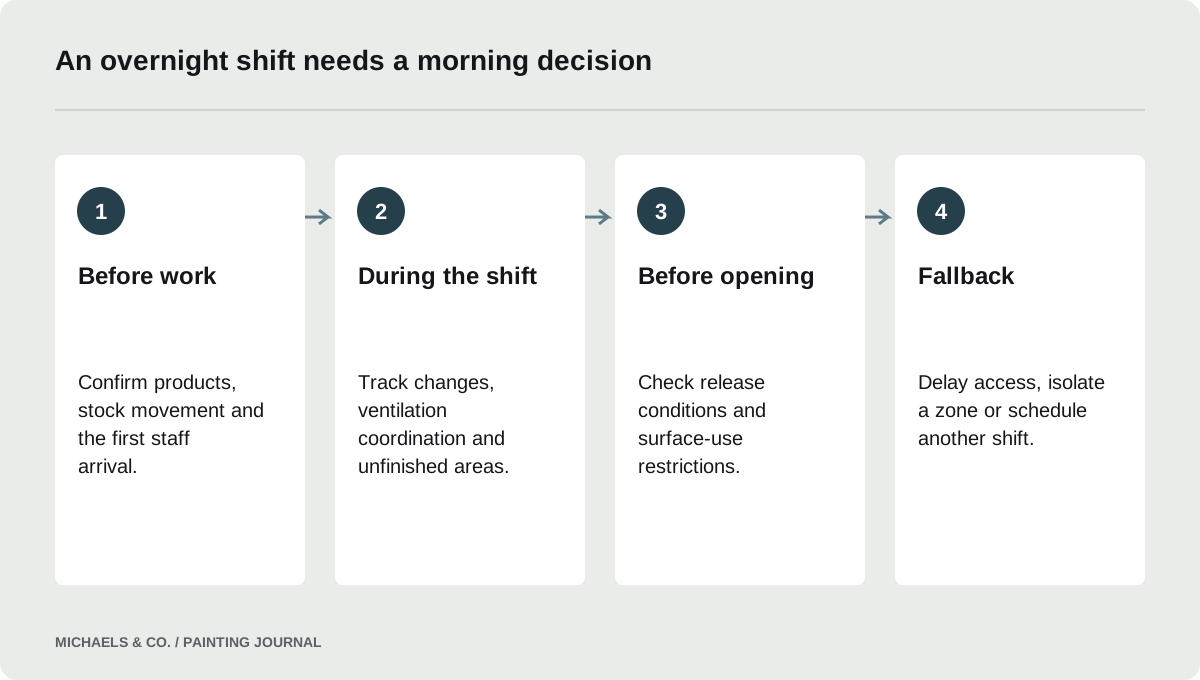
The reopening deadline is often earlier than the time printed on the shop door. Bakers, stockroom teams, cleaners and managers may arrive hours before customers. List those arrivals and the routes each person needs. A back-office repaint can disrupt the entire opening routine if keys, alarms, computers or staff belongings remain inside the restricted room.
A retail employee discussing an office repaint described limited ventilation and a room that could not simply be left open. That is a useful example of why the operating plan should precede the painting date. Ask whether work can be divided into zones, whether a temporary office is available and whether deliveries can be redirected. A plan based only on customer hours may overlook the people most likely to enter first.
Specify the complete coating system
The schedule should identify preparation materials and primers as well as the visible finish coat. A stain blocker, filler or specialty enamel may have different conditions from the wall paint. Ask for the actual product documents before accepting a promise that everything will be ready overnight.
Manufacturer instructions distinguish application and recoat conditions. For example, the Emerald Interior Satin data sheet provides drying information under stated conditions and notes that conditions affect timing. It does not establish a universal retail reopening interval. The current sheet for the product being supplied controls. If a substitute is proposed, revisit the schedule and protection plan rather than assuming every coating with the same color behaves identically.
Separate touching, handling and routine service
A display wall, a stockroom door and a sales counter face different demands the following morning. The wall may need only to remain undisturbed. The door will be handled repeatedly, while a counter might immediately be cleaned or have objects placed on it. Identify those uses before choosing products and promising access.
Create a surface schedule with three columns: intended service, applicable product instructions and temporary restrictions. Do not infer full service readiness from a finger test. Follow the manufacturer's guidance for cleaning, handling and returning surfaces to use; ask the technical department when the intended use is unclear. If the retail environment includes food preparation or other regulated activities, coordinate the finishing work with the responsible operating personnel rather than treating a general wall-paint specification as sufficient.
Keep business equipment and stock out of the work
Decide which items leave the area and which can stay under suitable protection. Merchandise, food packaging, textiles, paper records and electronic equipment do not all tolerate the same cleaning or contamination. Protection that works for a shelf may be inappropriate for a working register that someone must reach during the shift.
- Remove stock that cannot be reliably protected or cleaned.
- Assign movement of displays and electronic equipment to authorized staff.
- Photograph valuable fixtures and existing damage before work.
- Keep required access routes usable under the agreed building plan.
- Document who reinstalls displays after the surface is ready.
Allow time for moving things twice: out of the work zone and back into service. Leaving reinstatement out of the estimate can create a rushed opening even when the painting itself finishes on time.
Coordinate ventilation beyond the crew's shift
The painter may leave at midnight while building equipment switches to an unoccupied setting. That difference can undermine the expected drying and air-management conditions. Have facilities staff review the work period and the interval before employees return. Avoid improvised instructions to block or operate equipment without understanding the system.
The EPA's renovation guidance explains how timing, separation and ventilation work together. Its principles can inform retail planning, but it is not a store-specific clearance standard. In a bar-window painting discussion, an applicator worried about enamel odor persisting into service. Starting early helps only when the remaining conditions also support the intended use.
Write a morning release checklist
Name the person who checks the premises before staff restore stock or customers enter. This may require both a store representative and the contractor, with facilities or safety input where appropriate. The handover should verify the agreed conditions rather than rely on a text saying “finished.”
Check whether the specified work is complete, debris and application equipment have been removed, protected items can be uncovered, and any restrictions are clearly marked. Review changes made during the night, including unexpected repairs or substituted products. Record areas that remain unavailable. A visual finish inspection and an occupancy decision answer different questions: attractive walls do not prove that all operating conditions have been met. Conversely, an area may be usable while a minor cosmetic correction remains scheduled under the contract.
Price the fallback instead of improvising it
A realistic quote should state what happens if preparation reveals more damage, coverage requires additional work or an area cannot be released on schedule. Options might include another night shift, a delayed display installation or operating from only part of the premises. Their feasibility depends on the building and the business.
Agree who can authorize those changes, how the price will be determined and how quickly a decision must be made. Avoid telling a crew simply to finish at any cost while leaving recoat conditions and cleanup out of the conversation. Additional labor does not make a coating behave differently. If the business cannot tolerate any opening delay, consider a smaller work zone or a different schedule before contracting, rather than relying on an unsupported overnight guarantee.
Close out the work with operating instructions
Give staff a concise record of colors, products, affected surfaces and applicable care restrictions. A cleaner should not need to guess whether newly coated doors can receive the normal cleaning treatment. Keep the manufacturer's instructions available and identify the contact for unexpected marking, sticking or damage.
During the next operating period, note whether customers, stock movement or cleaning created contact that the plan overlooked. Those observations can improve the next stage. Photograph the accepted finish before fixtures are reinstalled where practical, so later damage can be distinguished from unfinished work. Retail repainting is often repeated across several areas; a clear handover saves more time than a vague assurance that the same approach will work everywhere in the store.
Questions & answers
Is dry-to-touch paint ready for a store to reopen?
Dry-to-touch describes only one condition of the coating. It does not answer whether the surface is ready for handling, cleaning, furniture contact or the building's planned occupancy. Use the exact product instructions together with the site plan, and identify which surfaces will receive immediate contact when the store opens.
Can we paint one half of a shop while the other half trades?
Possibly, if the work area, access and air paths can be managed appropriately. A visual divider alone does not establish adequate separation. Facilities and operating personnel should review the actual arrangement, including deliveries and emergency circulation, before customers or employees continue using the adjoining area.
Who should decide if opening must be delayed?
Assign that authority in advance to the business representative responsible for operations, with input from the contractor and relevant facilities or safety personnel. Record the release conditions and the fallback. Leaving the decision to whoever arrives first can result in staff removing barriers before the conditions have been checked.
Sources & further reading
- EPA renovation and repair IAQ guidanceEPA guidance recommends unoccupied scheduling, separation, ventilation coordination and daily cleanup; this is not a universal reopening rule.
- EPA controlling pollutants and sourcesEPA guidance connects coating selection, application schedules, furnishings protection and manufacturer instructions to indoor-air planning.
- Sherwin-Williams Emerald Interior Satin product dataExample manufacturer instructions specify recoat time and film build under stated conditions; use the actual selected product's current sheet.
Reader discussions
These conversations describe problems people encountered. They do not establish the cause of a defect or replace product instructions and applicable requirements.