Paint SDS, Product Data, and 'Low VOC': What Each Can and Cannot Tell You
Use a paint's safety data sheet to understand hazards and handling, and its product data sheet to understand application and service conditions. A low-VOC or low-odor label answers neither question completely and does not certify an occupied room as safe for everyone. Identify every product in the system, including primers and cleaners, then have the responsible professionals evaluate ventilation, work controls and any required respiratory protection.
Identify the exact product before reading the documents
The manufacturer, product line, sheen and intended use matter. A familiar brand may sell wall paint, specialty primer, industrial coating and cleaning products with very different instructions. Ask the contractor to provide a product schedule for the actual surfaces and keep it current when selections change.
A workplace painting discussion describes confusion over whether a strongly smelling product was water-based or oil-based. The participants' guesses cannot establish the material or exposure. Reading the correct label and obtaining the corresponding documents is a better starting point. Do not let information for the main wall coating stand in for a different primer used in one enclosed room.
Check the revision date and product identifier when downloading documents. A similarly named regional formulation or an older sheet may not describe the container supplied for the job; ask the manufacturer to resolve a mismatch.
Know what the safety data sheet is for
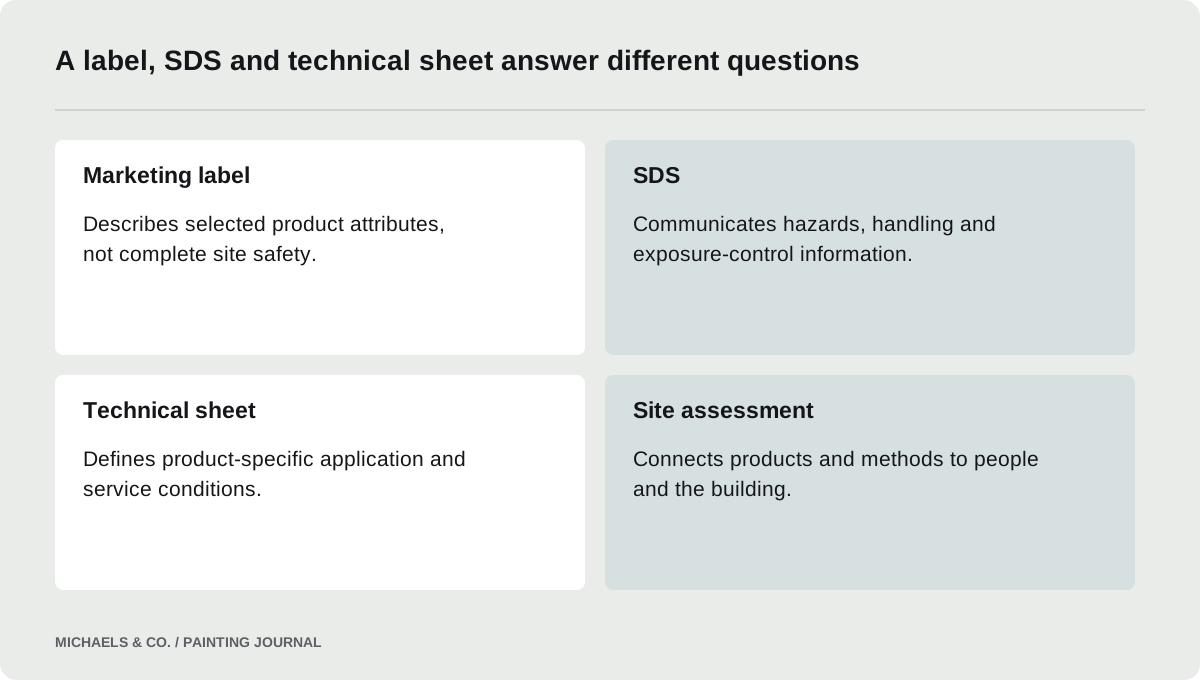
The safety data sheet, or SDS, communicates information about the chemical product's hazards and handling. It helps responsible personnel evaluate use, storage, exposure controls and response to incidents. It should be reviewed in relation to the actual work rather than filed as proof that no hazard exists.
A document containing reassuring language in one section may still require attention to application method, ventilation or other conditions. Ask the person responsible for safety to interpret the relevant information for the task. The SDS is not a personalized medical assessment, an air-test result or a building reopening certificate. If the proposed use differs from the document's intended context, obtain clarification from the manufacturer or another appropriately qualified professional before relying on it.
Use product data for application and return to service
A product data sheet, sometimes called a technical data sheet, addresses how the coating is intended to be prepared and applied. It may specify suitable substrates, environmental conditions, recoat intervals, coverage and other performance requirements. Those details vary by product and revision.
The Emerald Interior Satin sheet provides an example of drying information tied to stated conditions. Its values should not be transferred to another coating or interpreted as a universal occupancy interval. Distinguish dry-to-touch, recoat, handling, cleaning and service questions. If the needed information is absent or the intended use is unusual, ask the manufacturer for guidance rather than filling the gap with an assumed number of hours.
Understand the limits of low-VOC and low-odor claims
VOC content, perceived odor and the full hazard profile are related but different subjects. A marketing statement about one does not establish that every person can remain beside every application method. The work may also include dust, fillers, solvents or other products not covered by the wall paint's label.
The EPA's indoor-air source guidance connects product selection with scheduling, furnishing protection and ventilation considerations. Use those principles to plan the actual project. Avoid telling an affected occupant that a low-VOC label proves their reported irritation is imaginary. Equally, odor alone does not quantify exposure or identify a diagnosis. Record the product and conditions so an appropriate assessment can address the concern.
Distinguish particle filtration from vapor protection
A mask designed for particles does not automatically protect against gases or vapors. OSHA's respirator information for employees explicitly explains that distinction. Do not assume a disposable mask or a device with visible cartridges is suitable merely because it looks protective.
Required workplace respirator use must be evaluated under the applicable program. The OSHA respiratory protection standard addresses hazard-based selection and related employer responsibilities. This is not a task for an office worker to solve by buying a mask online. The responsible employer should assess the work and controls, including whether occupancy or the process should change, rather than treating personal protective equipment as a substitute for source management.
Read the documents together in a project review
Make a short review record that connects the documents to decisions.
| Information | Project decision |
|---|---|
| Product identity | Which surfaces and activities use it? |
| SDS | What handling and exposure questions need assessment? |
| Technical data | What application and service conditions apply? |
| Building plan | How are occupants, air paths and access managed? |
Assign responsibility for resolving open questions. A product may be technically suitable for a substrate while the proposed occupied application arrangement is unsuitable. Conversely, an adequate work zone does not fix a coating applied outside its instructions. Reviewing the information together prevents one approval from being mistaken for approval of every aspect of the job.
Reassess when products or methods change
A substitution can affect more than color or purchase price. A different primer, spray application instead of rolling, or work in an enclosed area may require the plan to be reviewed. Require the contractor to identify proposed changes before they occur and provide the relevant documents.
A customer's report of exterior product used indoors illustrates why intended use should not be inferred from brand familiarity. The post does not establish a technical diagnosis, but it provides a clear reason to verify the actual product. Keep the approved material schedule current and inform the facilities or safety personnel whose decisions depended on the original selection. Silent substitutions undermine both finish expectations and the basis of the work plan.
Respond to complaints without turning the label into a verdict
If someone reports odor, dust or feeling unwell, record the time, location, activity and products. Check whether the agreed controls and building arrangements were followed. Arrange appropriate technical or medical guidance where needed; neither the contractor nor a website should diagnose an individual's condition.
A workshop employee's account describes respirators being offered while spraying continued in a shared space. The specific workplace requires its own assessment, but the principle is clear: evaluate the source and work arrangement, not only what an affected person can wear. Retain the final documents and decisions so later maintenance does not repeat the same uncertainty about what was used and why the area was released.
Questions & answers
Does zero VOC mean no ventilation is needed?
No. Review the exact product, all other materials used and the actual work conditions. A VOC-content claim does not replace the SDS, application instructions or a site-specific exposure and occupancy assessment. Ventilation and other controls should be planned by the responsible professionals for the actual activity.
Can an N95 protect me from paint vapor?
A particulate respirator does not provide general protection against gases or vapors. Protection must match the assessed hazard, and required workplace use involves employer program responsibilities. Do not use a mask purchase as the sole response to an occupied-space painting concern; report the condition and have the work arrangement evaluated.
Which document tells me when furniture can touch the paint?
Look for the actual product's application, handling and service guidance, and ask the manufacturer if the intended use is not addressed. Dry-to-touch and recoat times do not necessarily answer furniture-contact or cleaning questions. The relevant timing depends on the coating and conditions rather than a universal rule.
Sources & further reading
- OSHA respiratory protection standardEmployers evaluate respiratory hazards, prioritize feasible engineering controls and operate required respirator programs.
- OSHA respiratory protection Appendix DA dust-particle respirator does not protect against gases or vapors; protection must match the hazard.
- EPA controlling pollutants and sourcesEPA guidance connects coating selection, application schedules, furnishings protection and manufacturer instructions to indoor-air planning.
- Sherwin-Williams Emerald Interior Satin product dataExample manufacturer instructions specify recoat time and film build under stated conditions; use the actual selected product's current sheet.
Reader discussions
These conversations describe problems people encountered. They do not establish the cause of a defect or replace product instructions and applicable requirements.