Lead-Safe Renovation Is Not Deleading: Choosing the Right Massachusetts Project
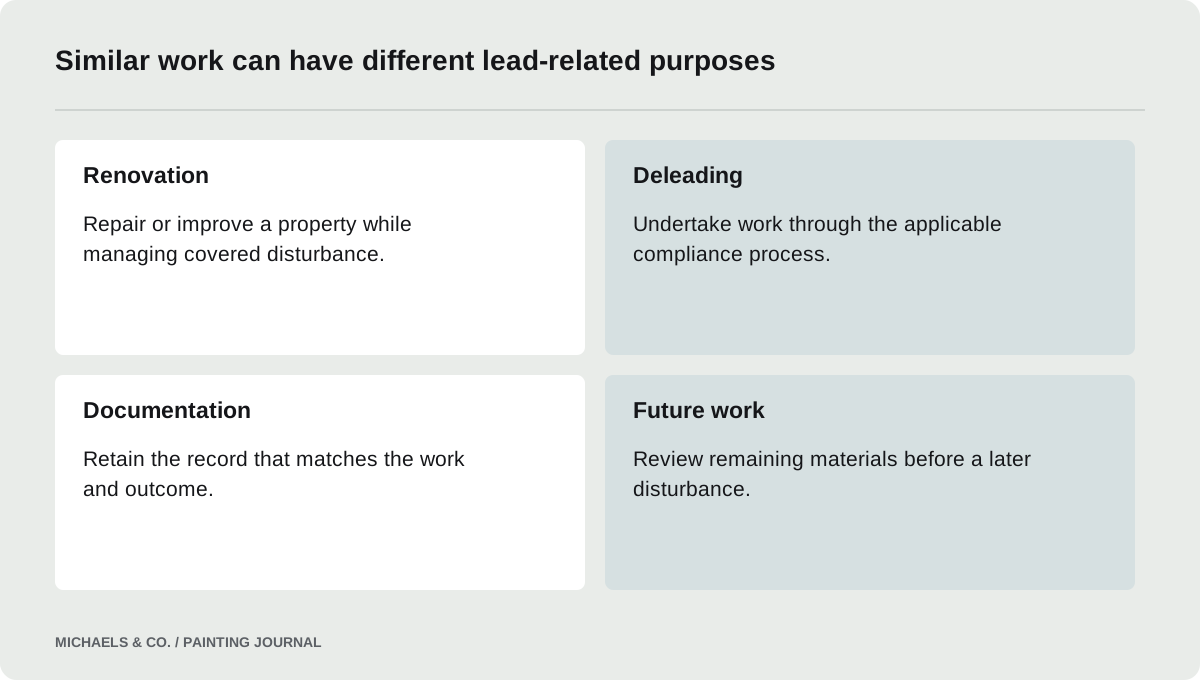
In Massachusetts, lead-safe renovation and deleading are distinguished by purpose and outcome. Renovation may disturb paint while repairing or improving a property; deleading is work intended to address lead hazards through the state's compliance process. A repaint performed with appropriate renovation controls does not automatically produce a Letter of Compliance or remove all lead. Define the intended outcome before selecting a contractor, credentials and documentation.

Begin with the result you need
An owner may want a better-looking exterior, replacement windows, repairs to damaged trim or a property brought into compliance with lead requirements. Those goals can involve similar-looking tools and surfaces, but they are not interchangeable project descriptions. Write down the desired result before asking for bids.
A homeowner's account of a withdrawn painting bid describes confusion after requests for lead-safe controls were treated as an abatement request. The post cannot establish the contractor's qualifications, but it highlights the terminology problem. Asking how a renovation will control lead dust does not necessarily mean the owner is commissioning a complete deleading project. Conversely, calling a job repainting does not remove requirements that apply to its actual disturbance.
Understand the Massachusetts distinction
The state's homeowner guidance explains that deleading seeks compliance with the Massachusetts lead law through the applicable process, while lead-safe renovation covers relevant work whose purpose is repair, improvement or appearance rather than abatement for compliance. The resulting documents and credentials need to match the project.
Use that distinction when discussing an estimate. Ask the contractor to state which type of work they are proposing and what outcome their price includes. Do not accept a sales phrase such as lead-safe house as a substitute for a defined scope. If compliance is required, establish the appropriate inspection and documentation route with the relevant state program or qualified professionals rather than assuming a painting invoice will satisfy it.
Do not confuse enclosure with complete removal
Lead-related work may leave older material in place under an approved approach, depending on the applicable scope and process. That possibility matters when later renovations will disturb the assembly. The document describing the earlier work is more informative than the fact that the surface now looks new.
In a Massachusetts owner's siding discussion, the owner described earlier enclosure and then considered removing the assembly during expansion. The article cannot verify the property's status or authorize that work. Its practical lesson is to review what remains and what later disturbance changes. Do not infer that a previous compliance outcome permits unrestricted future demolition, or that a compliant condition necessarily means every lead-containing component was physically removed.
Match qualifications to the specific work
Ask for the relevant business and individual credentials and verify them through the appropriate state channel. A general painting business registration, HIC registration or insurance document does not independently establish qualification for a particular lead scope. Likewise, a renovation credential should not be described as proof of authority to perform every kind of deleading.
The contractor should identify who will supervise, what work the crew will perform and whether another licensed professional is responsible for a separate part of the project. Record those roles in the agreement. If the job combines repair and compliance work, resolve the boundaries before mobilization. A homeowner should not have to infer the arrangement from whichever worker arrives first with a sander or a paint can.
Ask for distinct scope and documentation lines
A useful proposal identifies both the work and the evidence of completion. Request separate descriptions when painting follows another contractor's lead-related work.
| Project question | What the agreement should explain |
|---|---|
| Purpose | Renovation, compliance work or separate coordinated scopes |
| Responsibility | Named business and qualified professionals for each stage |
| Protection | Applicable occupant and work-area arrangements |
| Completion | Required checks and the documents actually produced |
Do not treat a certificate-shaped document as self-explanatory. Read its issuer, property identification, date and stated meaning. Keep the complete record, including limitations, rather than only the page that appears most reassuring.
Recognize the added issues in childcare settings
A home daycare or a commercial property with a qualifying child-occupied facility may require special attention to the applicable lead framework and the operating schedule. The EPA's childcare guidance explains why facility use matters, while Massachusetts requirements must be applied to the state project.
Do not assume the absence of residential use makes every commercial area outside lead renovation rules. Conversely, do not describe an entire building as covered without evaluating the actual definition and affected areas. Identify where children regularly spend time, what surfaces will be disturbed and who controls occupancy. Coordinate the legal scope and the practical work plan separately so neither is reduced to a vague instruction to work when the children are away.
Avoid ordinary-paint shortcuts to a compliance promise
A new finish may improve appearance and protect a suitable surface, but the product alone does not establish that the Massachusetts compliance process has been completed. Ask what system is proposed, what the applicable requirements are and who determines completion. Do not make a household paint choice carry a legal or technical meaning it does not have.
Similarly, a contractor's promise to be careful is not a substitute for the relevant licensed process. The distinction should remain clear even when the same firm can perform more than one type of work. If the desired outcome changes during the project, pause and revise the scope, professional responsibilities and documentation requirements before continuing. A compliance objective should not be added casually to an ordinary repaint at the final invoice stage.
Use the property record for future decisions
After work, store the reports, relevant licenses or verification records, completion documents, product information and photographs together. Note which surfaces were addressed and which questions remain outside the scope. Future owners, tenants and contractors may need that history when planning another repair.
If later damage or remodeling affects a previously treated area, provide the records to the professionals assessing the new work. Ask what the change means rather than assuming the old outcome answers every future question. The useful distinction is durable: renovation records explain a particular work process, while compliance documents explain the outcome of the relevant compliance process. Neither should be expanded into an unsupported claim that the property is universally lead-free or that any future disturbance is unrestricted.
Questions & answers
Can the same company perform renovation and deleading?
Possibly, if it holds the qualifications required for each actual scope and follows the relevant process. Verify the specific credentials and named responsibilities rather than relying on the company's general description. The contract should identify which service is being purchased and what completion documentation it will produce.
Does a Letter of Compliance mean every lead-containing material was removed?
Do not assume that from the document's name. Review the actual report and completed work with the relevant qualified professional or state program. Compliance and complete physical removal are not interchangeable concepts. The distinction becomes especially important when later renovation will disturb previously treated or enclosed components.
Should I request deleading whenever an old house needs painting?
The appropriate project depends on the property's obligations, conditions and your intended outcome. A repaint may require lead-safe renovation controls without being a deleading project. If compliance is the objective or required by the circumstances, establish that scope through the appropriate Massachusetts process before requesting bids.
Sources & further reading
- Massachusetts lead-safe renovation for homeownersState LSR licensing and supervisor rules differ from deleading; renovation does not produce a Letter of Compliance.
- EPA RRP for childcare operatorsPre-1978 qualifying child-occupied facilities can fall under RRP, including portions of commercial properties.
Reader discussions
These conversations describe problems people encountered. They do not establish the cause of a defect or replace product instructions and applicable requirements.