Lead-Safe Painting and Worker Safety Are Separate Responsibilities
Lead-safe renovation credentials do not replace an employer's responsibility to protect workers from lead exposure. OSHA's construction lead standard covers relevant painting and repair work and requires an appropriate exposure assessment and protective measures. Massachusetts LSR requirements address a separate renovation framework. Employers must plan for employees and other affected trades before disturbance begins, including controls, required respiratory protection, hygiene and prevention of take-home contamination.
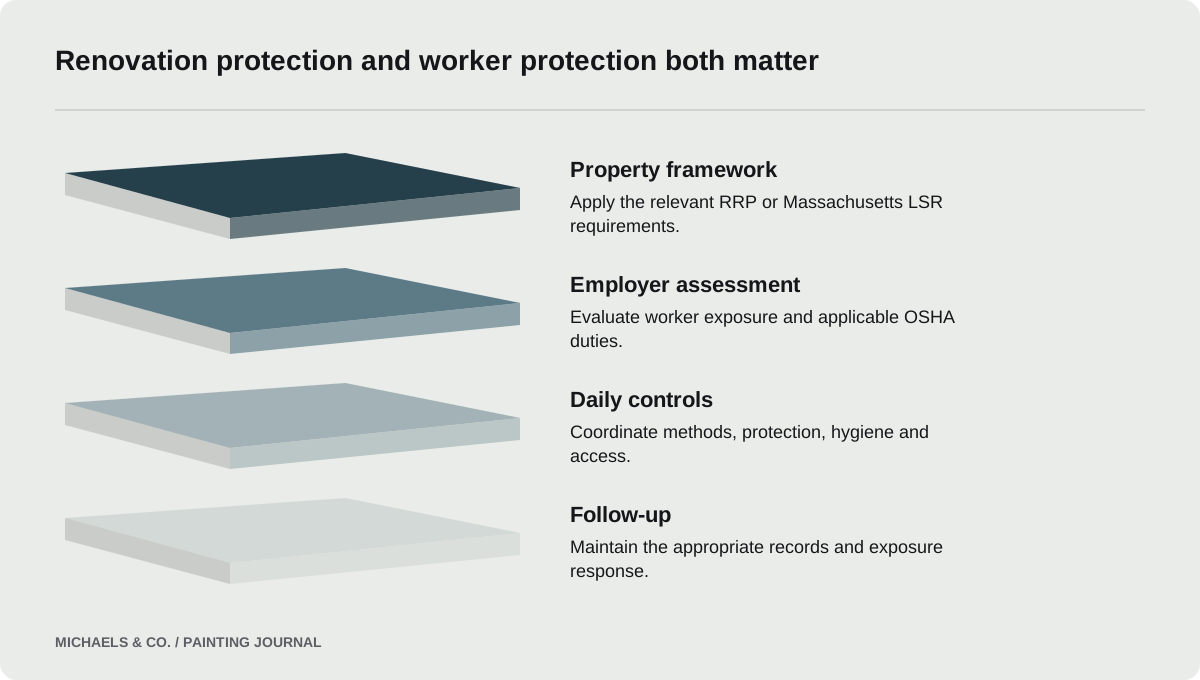
Recognize the two different responsibilities
A project may need lead-safe renovation controls to protect occupants and the surrounding area while also creating occupational exposure concerns for the people doing the work. Satisfying one framework should not be presented as automatic compliance with the other. Identify the employer responsible for each crew and the professionals directing the work.
The OSHA construction lead standard expressly includes relevant painting and decorating work within its scope. Massachusetts LSR guidance addresses the state's renovation requirements. A business should review both as applicable to the actual activity. A homeowner's request for a credential does not complete the employer's exposure assessment or establish that every worker has the protection their task requires.
Assess the work before workers are covered in dust
Identify materials, methods, duration and the people who may be exposed. The employer must evaluate the applicable requirements and establish controls before hazardous work is treated as routine. A casual statement that an old house is probably fine is not an assessment.
A painter's account of learning about lead after sanding describes concern both for personal exposure and for a child at home. The account cannot establish the exposure level, but it highlights the timing failure: the information arrived after the worker had already performed the task. Workers need understandable instructions and a way to raise uncertainty before starting, not reassurance after contamination may have occurred.
Include other trades and intermittent visitors
The painter is not necessarily the only worker affected. Electricians, installers, cleaners and supervisors may enter the area during or after disturbance. Coordinate the work sequence and access restrictions so a different employer does not send workers into a condition they have not been told about.
An electrician's discussion about a Victorian remodel describes uncertainty about returning after another crew dry-sanded suspected lead paint. The forum cannot certify when the area is suitable for re-entry. The relevant employers and responsible professionals should establish the conditions and documentation needed for access. A promise that someone will clean up later does not explain what work was performed or what process will support the release decision.
Use controls before treating respirators as the entire solution
Respiratory protection is one element of an occupational protection program, not a replacement for controlling the source. The employer should evaluate feasible engineering and work-practice controls and the requirements that apply to the task. Do not leave individual workers to assemble their own protection from internet recommendations.
The OSHA respiratory protection standard describes hazard-based selection and program requirements for required respirator use. The relevant lead provisions also matter. Selection, medical evaluation, fit testing, training and maintenance must be addressed as applicable. A mask that looks substantial or has replaceable parts does not prove it is suitable. The program should explain who evaluates the hazard and how the chosen protection will be used correctly.
Plan hygiene and take-home contamination controls
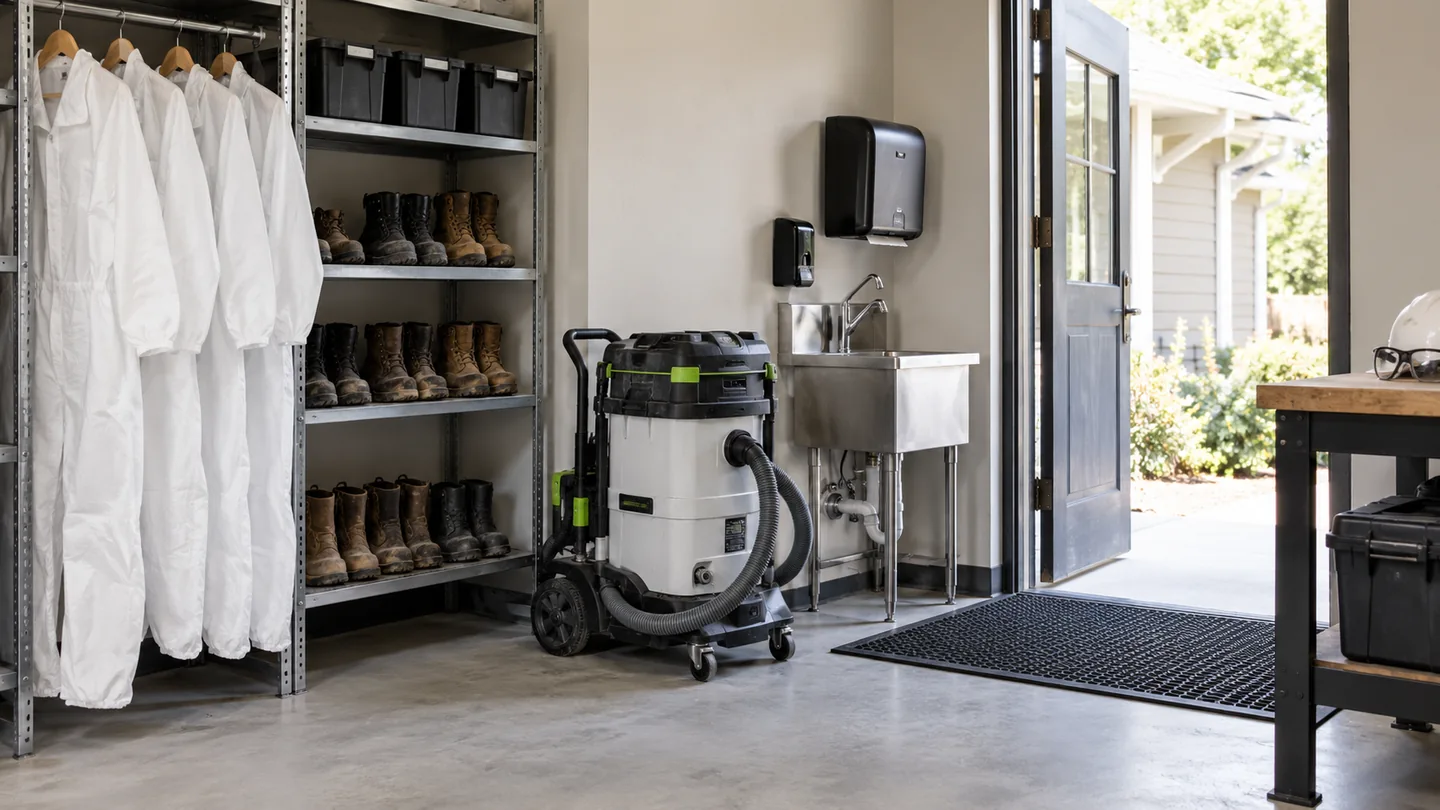
Work clothing, footwear, tools and vehicles can carry material beyond the work area. The employer's plan should address applicable hygiene, changing, housekeeping and decontamination requirements so workers are not left to improvise when they return home. Review the construction lead standard for the conditions that trigger specific obligations.
| Work stage | Planning question |
|---|---|
| Before the task | What information, assessment and protection are required? |
| During work | How are exposure and movement controlled? |
| Leaving the area | How are clothing, equipment and hygiene handled? |
| After the shift | What records, follow-up or medical arrangements apply? |
This is a management framework, not a home cleanup recipe. Potential contamination should be addressed through qualified guidance rather than shifting the responsibility onto family members.
Provide training that matches the actual job
Workers need to understand the materials, activities, controls and reporting process relevant to their assignment. A certificate from a different course does not necessarily answer every workplace requirement. Explain what to do when an unexpected layer, damaged containment or changed method creates uncertainty.
Supervisors should be able to identify the stop point and the person who can authorize a revised approach. Training should also reach replacement workers and subcontracted crews, not only the original team. Keep language and instructions understandable to the people performing the work. A signed attendance sheet is a record, but its practical value depends on whether workers can use the information when the conditions change and whether management responds to concerns without dismissing them.
Respond to potential exposure through the proper channels
If a worker believes they were exposed without the planned controls, they should report the circumstances and seek appropriate occupational or medical guidance. Record the task, dates, materials and protection used. The employer should review the applicable standard's assessment, medical and follow-up requirements.
Do not diagnose lead poisoning from symptoms or assume the absence of symptoms proves no exposure. Medical questions require qualified evaluation. If workplace concerns are not addressed, workers can seek guidance from the appropriate occupational-safety authority. Keep the report factual and avoid advice to continue the same task with an improvised mask while waiting for clarification. The immediate priority is an appropriate assessment of the work and protective measures, not assigning blame before the facts are understood.
Keep owner verification distinct from employer management
A property owner can request relevant credentials, a defined work plan and appropriate project records. That does not make the owner qualified to select respirators or certify worker exposure controls. Employers retain their own responsibilities, and the contract should not blur them into a general promise that the homeowner will supervise safety.
At closeout, retain the renovation documents relevant to the property and identify any unresolved conditions before other trades enter. Employers should maintain their required occupational records through the appropriate process, including confidential information handled correctly. The two record sets may relate to the same project but serve different purposes. Clear separation helps everyone ask the right questions without mistaking a neat finished room or a renovation certificate for a complete occupational-safety determination.
Questions & answers
Does an LSR credential prove workers are protected under OSHA?
No. Renovation credentials and occupational protection address different requirements. The employer must assess the actual exposure and implement the applicable controls and protection program. Ask who is responsible for each framework rather than assuming one certificate establishes compliance with every worker-safety obligation.
Can another trade enter after the painters say they cleaned up?
The responsible employers and project professionals should establish the applicable release conditions and records. A verbal assurance alone does not describe the activity, contamination or cleanup process. Coordinate access and provide relevant information to the other trade before workers are sent into the affected area.
Should a worker rely on symptoms to decide whether lead protection is needed?
No. Protection decisions should be based on the work and applicable exposure requirements, not on whether someone currently feels ill. Suspected exposure or symptoms warrant appropriate occupational and medical advice. The absence of symptoms does not replace an assessment, and an online discussion cannot determine an individual's exposure or diagnosis.
Sources & further reading
- OSHA 29 CFR 1926.62 LeadConstruction lead standard covers painting and establishes employer exposure assessment, controls, hygiene and applicable protection requirements.
- OSHA respiratory protection standardEmployers evaluate respiratory hazards, prioritize feasible engineering controls and operate required respirator programs.
- Massachusetts lead-safe renovation for homeownersState LSR licensing and supervisor rules differ from deleading; renovation does not produce a Letter of Compliance.
Reader discussions
These conversations describe problems people encountered. They do not establish the cause of a defect or replace product instructions and applicable requirements.