Massachusetts Painting Credentials: HIC Registration, Lead-Safe Licensing, and What Each Covers
Check a Massachusetts painter's credentials against the actual work, not a generic demand for a painting license. The state lists interior painting among HIC registration-exempt activities, while exterior or mixed improvement scopes may need separate review. Disturbing covered older paint can require Massachusetts lead-safe renovation credentials regardless of that interior-painting exemption. Registration, lead qualifications, insurance and a workmanship promise are different forms of evidence and should not be treated as interchangeable.

Write the scope before searching a registry
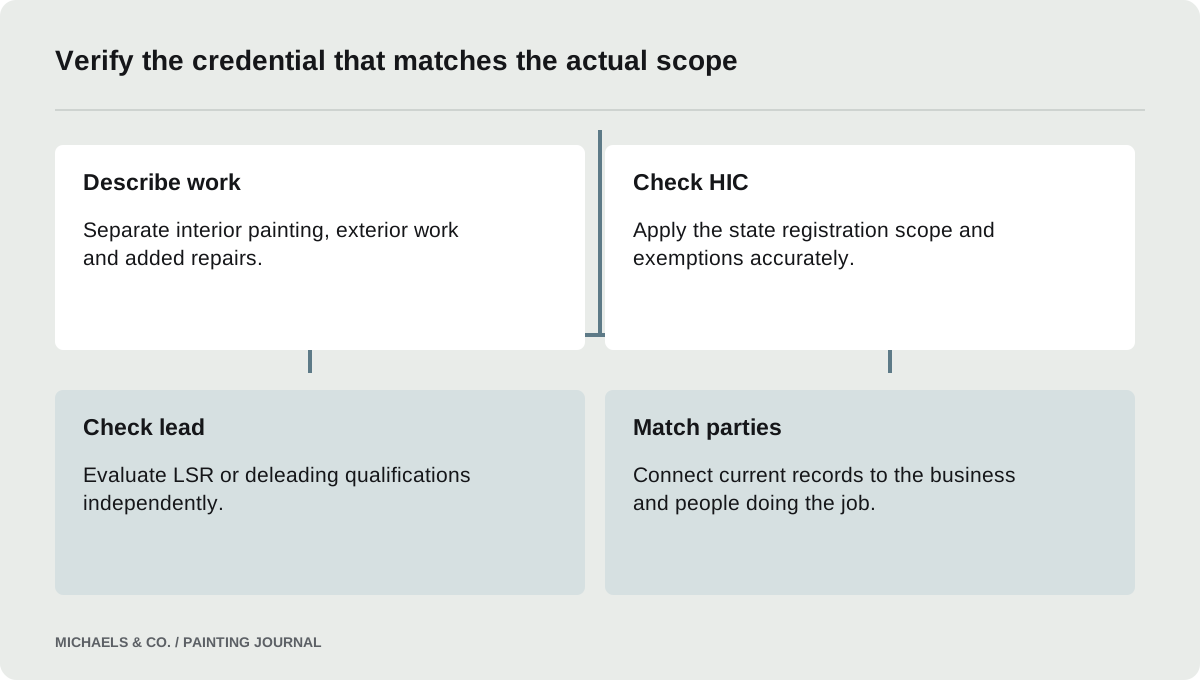
List the actual activities: interior finish application, scraping, sanding, exterior coating, carpentry, component replacement or other repairs. Identify the building type and age. A company that performs several services may need different credentials for different jobs, so its business description alone does not settle the question.
A prospective Massachusetts interior painter's discussion describes conflicting online claims about licensing and the state's interior-painting exemption. That confusion affects customers too. Begin with what the contract requires the firm to do. A registry search is useful only when you know which registration or license is relevant. Do not reject or approve a bidder solely because one broad online checklist says every painter must display the same credential.
Understand the interior-painting HIC exemption
The Massachusetts HIC homeowner resources list interior painting among activities that do not require HIC registration. The exemption should be described accurately rather than omitted from a generic homeowner checklist.
It does not mean that any company using the word interior is exempt from every requirement, or that an interior-painting contract has no legal obligations. Mixed scopes and separate laws still need to be considered. Nor does an exemption establish that the contractor is skilled or insured. Keep the narrow question narrow: whether HIC registration is required for the actual work. If the proposal includes other improvement activities, ask the state program or an appropriate adviser to clarify how the combined scope is treated.
Review exterior and mixed scopes separately
An interior repaint with additional repairs may differ from an interior-only scope. Exterior work and other home improvements can raise different HIC questions. Do not apply the interior exemption to the entire proposal merely because most of the price is for paint.
Ask the contractor to identify which business will perform each part and what relevant credentials are held. If subcontractors are involved, clarify their role and the party responsible for the overall agreement. Record the state program's guidance when the scope is ambiguous. A homeowner should not need to interpret every trade boundary alone, but they do need a clear description of the work to obtain a useful answer. Vague estimates make credential verification harder as well as making price comparison less reliable.
Check lead-safe renovation qualifications independently
Preparation on relevant older housing or child-occupied facilities can create a separate lead-safe renovation requirement. The Massachusetts LSR guidance describes contractor licensing and supervisor requirements for covered work. An HIC registration or an interior-painting exemption does not answer that separate question.
A homeowner's report of confusion between renovation and abatement shows why the requested credential must match the project purpose. Ask whether the work is renovation or a separate deleading scope, who will supervise and what completion documents will be provided. A broad statement that the crew is careful around old paint is not a substitute for verifying the applicable state qualifications and work process.
Match the credential to the contracting party
Compare the business name in the proposal, credential record and payment documents. Ask about a mismatch before signing. A salesperson may use a trade name while the legal contracting party has another name, but the relationship should be clear and documented.
Confirm the relevant credential's current status through the appropriate official channel, including the information needed to distinguish similarly named businesses. Keep the date and result of the check. Do not rely only on a screenshot supplied years earlier or a credential belonging to someone who is not responsible for your job. If an individual supervisor's role matters, ask how that role is maintained when staffing changes. Verification should establish who is actually undertaking the work, not merely that a familiar name exists somewhere in a database.
Keep insurance and workmanship evidence separate
Insurance information concerns potential coverage under particular policies; it does not prove technical competence or replace a required license. A certificate may be useful documentation, but it is not a guarantee that every incident will be covered. Ask for the relevant information and clarify material questions through the appropriate insurer or adviser.
| Evidence | What it does not automatically prove |
|---|---|
| HIC registration | Every lead-related qualification or a flawless finish |
| LSR credential | Deleading authority or complete property lead removal |
| Insurance certificate | Coverage for every possible claim |
| Warranty | Protection against every substrate or building condition |
References, samples and a detailed scope help assess workmanship expectations, but they too should be understood as evidence with limits rather than substitutes for one another.
Verify the proposed people and process
Ask who will lead the work, whether subcontractors are expected and how changes in personnel will be communicated. For scopes with specific supervision requirements, the plan should explain how those requirements will be met throughout the relevant work. Avoid assuming the person who prepared the estimate will personally perform or supervise every task.
The owner can request a clear plan without taking over the employer's technical safety responsibilities. Keep worker exposure management, occupant protection and finish acceptance distinct. If the contractor cannot explain which qualifications apply, pause the procurement decision and seek an authoritative answer. The objective is not to demand every conceivable certificate; it is to obtain the credentials and accountable process relevant to the work that will actually happen on the property.
Retain a verification record with the agreement
Keep the final scope, named parties, relevant credential checks, material schedule and agreed completion documents together. Record any official clarification about an exemption or mixed scope. If the work changes materially, revisit the qualifications rather than assuming the first check covers the new activity.
A concise record also helps with later questions about complaints or remedies. HIC enforcement and other processes have their own scope and eligibility; the absence or presence of a registration should not be expanded into a promised recovery outcome. The practical result of verification is an informed hiring decision and a clear project file. It should neither falsely disqualify an exempt interior-only painter nor excuse missing lead-related qualifications when the actual work requires them.
Questions & answers
Does every Massachusetts interior painter need HIC registration?
The state lists interior painting among HIC registration-exempt activities. Check the actual scope, especially when repairs or other improvement work are included. The exemption does not settle separate lead-safe renovation, insurance or contractual questions. Obtain official clarification for an ambiguous mixed proposal.
If a painter has HIC registration, are they qualified to disturb lead paint?
Not on that fact alone. Massachusetts lead-safe renovation has separate licensing and supervision requirements for covered work. Review the building, preparation and available records, then verify the relevant LSR qualifications. Deleading for compliance is another distinct scope that must be matched to appropriate credentials.
Should I trust a license number shown on a website?
Use it as a starting point and verify the current official record. Match the business and any relevant individual to the contracting party and proposed work. Retain the date of the check and ask about discrepancies. A displayed number alone does not establish current status or applicability to your project.
Sources & further reading
- Massachusetts HIC homeowner resourcesState guidance: interior painting is exempt from HIC registration; covered-work remedies require scope and eligibility checks.
- Massachusetts lead-safe renovation for homeownersState LSR licensing and supervisor rules differ from deleading; renovation does not produce a Letter of Compliance.
Reader discussions
These conversations describe problems people encountered. They do not establish the cause of a defect or replace product instructions and applicable requirements.