Painting Deposits in Massachusetts: Check the Job Type Before Applying the One-Third Rule
Before applying Massachusetts' HIC deposit rules to a painting job, determine whether the actual work falls within that law. The state lists interior painting among registration-exempt activities, so rules for covered home improvement work should not be generalized to every interior repaint or commercial contract. For covered HIC work, the advance-payment limit and special-order exception matter. For any job, use a clear written payment schedule tied to identified work and keep receipts.

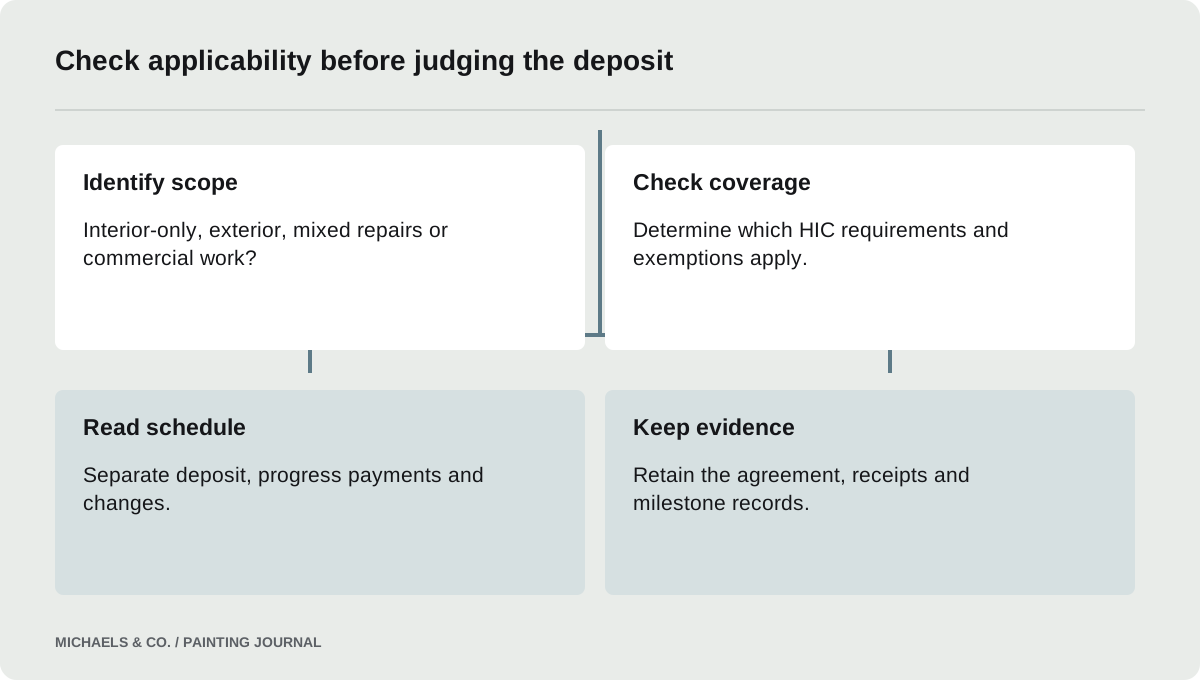
Start with the work, not the contractor's sales label
A company may offer painting, carpentry, siding repair and other services under one name. The word painting on its website does not establish the legal treatment of a particular contract. List the actual work: interior coating only, exterior repainting, repairs, replacements or a combined improvement project.
The Massachusetts HIC homeowner guidance identifies interior painting as an activity that does not require HIC registration. That is a significant limitation on broad online claims about all painting deposits. It does not mean an exempt contract has no enforceable terms or consumer protections. It means the applicability question must be answered before a homeowner relies on a specific HIC rule or remedy. Ask the state program or a qualified adviser about an uncertain mixed scope.
Understand the covered-work advance-payment rule
For work subject to the HIC framework, the state's contract guidance describes the limit on payment demanded before work begins: the greater of one-third of the total contract price or the actual cost of qualifying special-order or custom-made materials or equipment needed in advance. The exception is not a general permission to collect any amount described as materials.
Use the current rules and the actual covered scope when reviewing a proposed deposit. Ask what item supports an exception and how its cost is documented. Do not combine a forum's preferred payment split with a state rule and present the result as law. A painter's usual business practice does not establish that the same deposit arrangement is suitable or lawful for every contract.
Distinguish a deposit from later progress payments
A scheduling deposit, payment on mobilization and payment after completed work are different events. The contract should identify each amount, when it becomes due and what the payment represents. Avoid a schedule that changes meaning depending on whether the contractor calls the money a deposit, advance or installment.
A discussion among painters about deposits contains widely different preferred percentages and milestones. Those comments illustrate business variation, not Massachusetts legal requirements. Review the actual timing and substance of the requested payment. If the contractor wants additional money after starting, ask whether it is a scheduled installment, an authorized change or an unscheduled advance. Keep those categories separate in the payment record.
Use milestones that can be verified
A milestone should identify completed work rather than a vague percentage of effort. “Preparation completed in the listed rooms” is easier to review when the scope defines that preparation. “Halfway done” can mean different things to the owner and the painter, especially when setup and repairs consume much of the labor.
| Payment event | Record to retain |
|---|---|
| Before work | Contract, amount, purpose and receipt |
| Progress stage | Defined completed scope and inspection notes |
| Approved change | Added work, price and authorization |
| Closeout | Completion status and agreed correction record |
This is a planning example, not a required payment formula. The appropriate structure depends on the project, applicable law and negotiated terms.
Treat personal-expense requests as a separate concern
A contractor's vehicle repair, rent or another customer's project does not explain what has been completed on your job. If an unscheduled request arrives, ask for its contractual basis and the updated work schedule. Do not let sympathy replace a clear record of what you are paying for.
An Australian homeowner's report describes a long-delayed start after a deposit and later requests for personal expenses. Its legal context is not Massachusetts, but the practical warning is transferable: repeated advances can leave the owner fully paid up before receiving the agreed work. A request alone does not prove fraud. Assess the explanation, progress and documents, and avoid expanding your exposure without a defensible project reason.
Check the named business and payment record
The contracting party, invoice and payment recipient should be understandable and consistent. Ask about discrepancies before paying. Keep the signed agreement, receipts, transaction details and messages confirming what each payment covers. Record any approved change in the same file.
The FTC's home improvement guidance identifies pressure and payment-related warning signs and encourages clear written records. Use that guidance to slow down an unclear transaction, not to assume that every small contractor is dishonest. If a payment method is changed unexpectedly, verify the request through a trusted contact route. A useful receipt identifies the business, project, amount and date rather than merely acknowledging that money was received.
Review completion and dispute terms before trouble arises
Read how the agreement defines completion, handles corrections and addresses a delayed start. For covered HIC work, the state contract framework includes requirements that need to be applied accurately. For exempt or commercial work, do not pretend the same HIC mechanism automatically governs the dispute.
Discuss what will happen if weather, access or discovered conditions alter the schedule. Identify who can approve a change and how an unstarted project can be addressed under the agreement. If the contractor has already missed commitments, document the sequence before deciding on cancellation or payment withholding. Those actions can affect rights and should be evaluated against the actual contract. A payment schedule is useful only when the related scope and timing are also clear.
Use the right help route for the actual problem
Massachusetts homeowner guidance describes complaint and dispute options, but eligibility and the role of each process differ. An enforcement complaint is not necessarily a money-recovery process, and HIC remedies should not be assumed available for every exempt activity or every claimant. Verify the appropriate route before relying on a promised outcome.
Prepare a concise file containing the scope, parties, payments, dates and specific unresolved issue. That lets a state program, mediator or legal adviser assess the relevant facts efficiently. The goal is to avoid both common errors: accepting any requested deposit because it is the painter's norm, or declaring every interior-painting deposit above one-third unlawful without first checking whether that HIC provision applies to the job.
Questions & answers
Is every Massachusetts painting deposit limited to one-third?
Do not assume that. First determine whether the actual scope is covered by the HIC law; the state lists interior painting among registration-exempt activities. Covered work has an advance-payment rule with a qualifying special-order exception. Mixed scopes and disputed applicability should be checked with the state program or a qualified adviser.
Does the interior-painting exemption mean I should skip a written contract?
No. A written scope, material schedule, dates and payment terms remain useful even when a particular HIC requirement does not apply. The exemption is not a reason to leave the agreement vague. Document what you are purchasing, how changes are approved and what each payment covers.
Can a painter request another advance after starting?
Ask whether it is an agreed progress payment, an approved change or an unscheduled request. Review the completed work and the contract before deciding. A new label does not explain the payment's purpose. If the request is disputed or creates concern about completion, preserve records and seek advice appropriate to the project.
Sources & further reading
- Massachusetts HIC homeowner resourcesState guidance: interior painting is exempt from HIC registration; covered-work remedies require scope and eligibility checks.
- Massachusetts home improvement contract sample languageCovered HIC contracts require detailed scope, materials, dates and payment terms; applicability must be checked.
- FTC: How to avoid a home improvement scamFTC consumer guidance favors written scope and documented payments and identifies pressure and advance-payment warning signs.
Reader discussions
These conversations describe problems people encountered. They do not establish the cause of a defect or replace product instructions and applicable requirements.