Painting Laminate Shelves: Adhesion, Blocking and Realistic Wear Limits
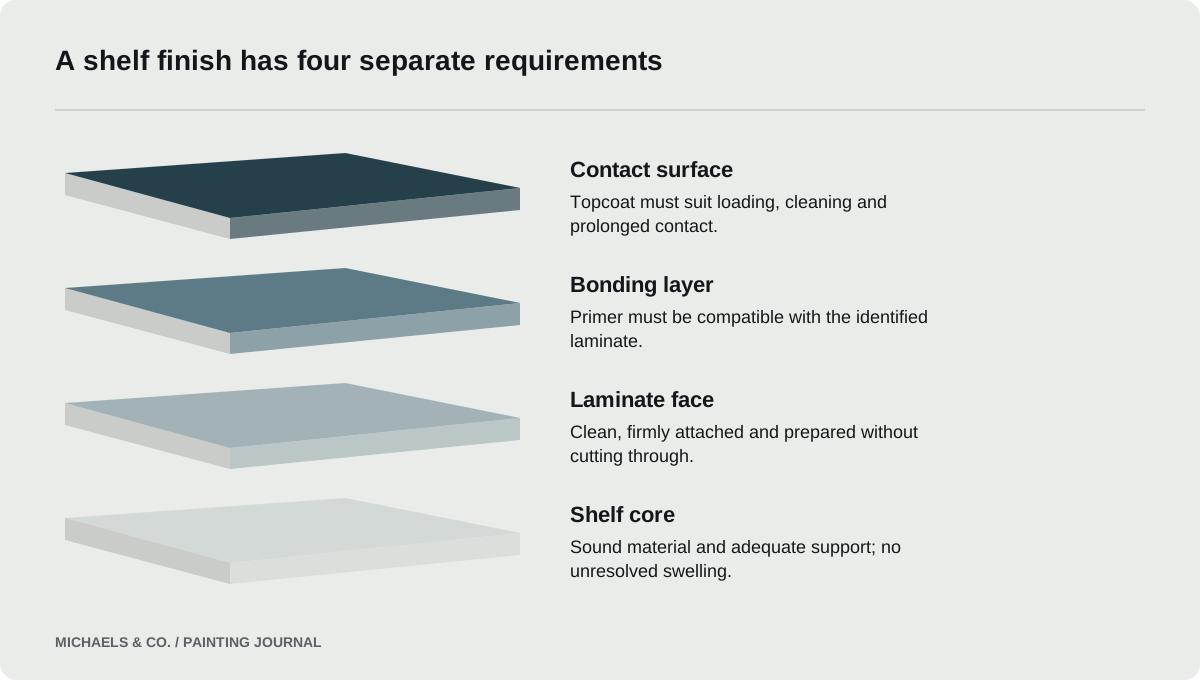
Laminate shelves can sometimes be refinished successfully, but adhesion is only the first requirement. A horizontal shelf also needs a finish that tolerates prolonged contact with stored objects. Confirm that the laminate is firmly attached, use an approved bonding system and allow the topcoat to develop its specified service properties before loading it. Swollen particleboard, lifting edge strips or demanding wear may make replacement more practical than painting.
Identify what the shelf is made of
A shelf described as laminate may have high-pressure laminate, a melamine surface, a decorative foil or an existing painted finish over a wood-based core. These surfaces do not automatically accept the same preparation or primer. Inspect an edge, an unused shelf or the manufacturer's information before treating the glossy face as generic plastic.
In a Reddit question about laminate closet and pantry shelves, the concern was whether a primer would make the repaint reliable. The complete answer also depends on what will sit on the shelf. A decorative vertical panel and a pantry shelf carrying cans have different service conditions. Write down the surface identity and expected use before selecting a product that happens to advertise strong adhesion.
Repair the shelf structure before its appearance
Check for sagging, swollen corners, loose edge banding and laminate that lifts from the core. Paint cannot reattach a separating laminate sheet or restore a particleboard edge that has expanded after getting wet. Loading the shelf may keep moving those defects beneath an otherwise attractive new finish.
Inspect supports and exposed cutouts too. An edge beside plumbing may have a different moisture history from the protected center. Determine why damage occurred before deciding that a filler and paint will be enough. Small sound edge defects may be repairable with a compatible method, but extensive swelling or unstable facing can make a new shelf more economical. Include the time needed to remove and reinstall the shelf in the comparison, not just the cost of a can of primer.
Remove contamination before creating a scratch pattern
Pantry and closet shelves accumulate grease, cleaning products, waxy residues and marks from stored objects. A surface can look clean yet still interfere with adhesion. Choose a cleaner suitable for the laminate and the proposed coating, follow its residue-removal directions and let the surface reach the required dry condition.
Do not start by grinding contamination into the face. After cleaning, use the preparation required for the chosen bonding system. The goal of deglossing is a suitable surface, not removal of the thin decorative layer. Sanding through to the core creates a new absorbency problem and may leave a visible boundary. Protect adjacent surfaces and manage dust. If the shelf carries an unknown old coating rather than bare laminate, assess that coating before abrasion.
Test a complete coating system on a representative area
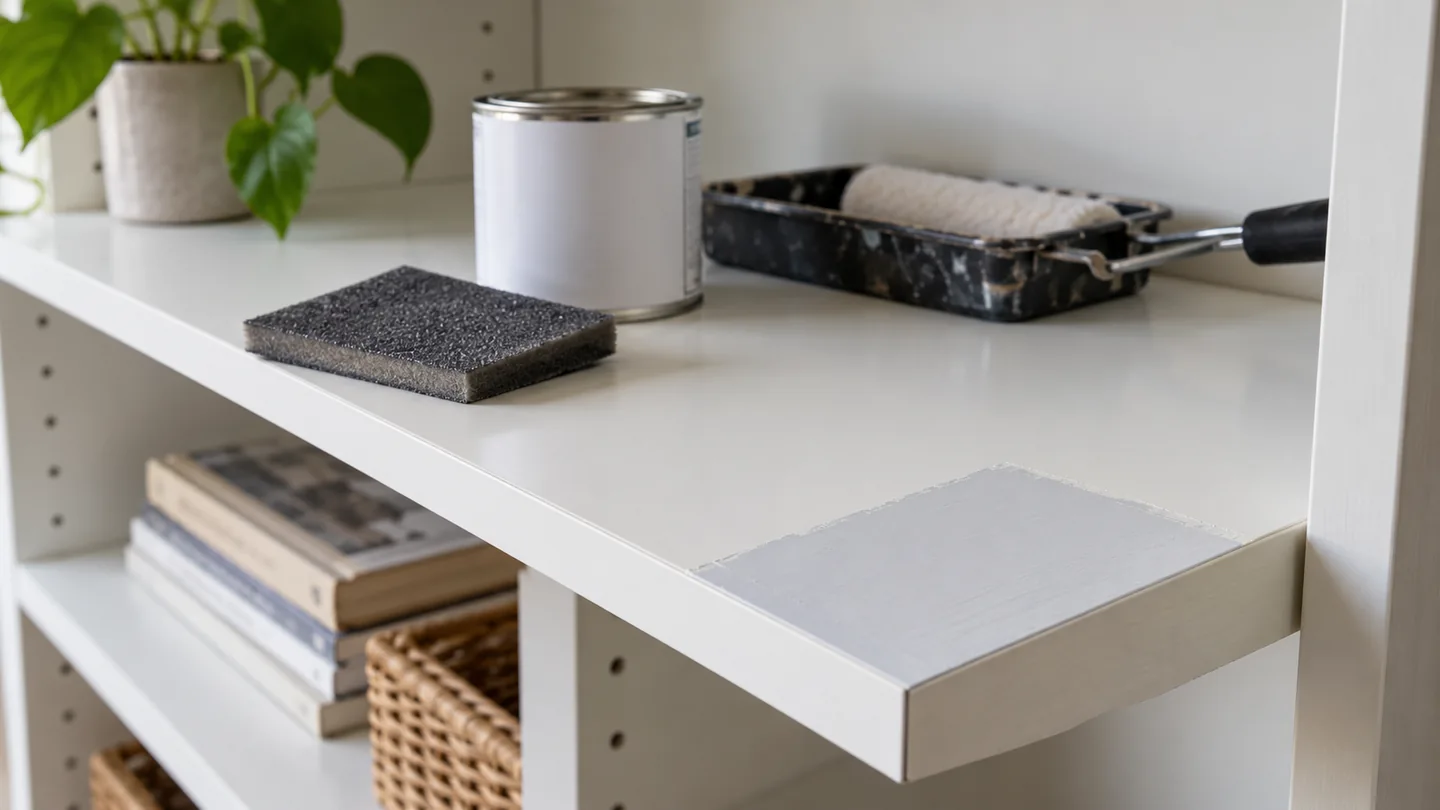
A primer label listing difficult surfaces is a useful starting point, not proof that every laminate formulation and factory treatment will behave alike. Use an offcut or a discreet representative area. Include an edge if the finished project contains exposed edge banding, because the face and edge may not be identical materials.
The INSL-X Stix SXA-110 technical sheet, for example, recommends deglossing challenging glossy surfaces and testing questionable substrates. Its latex/oil topcoat window and development of scrape resistance are different milestones. Complete the intended topcoat on the sample and evaluate it at the relevant stage. An immediate fingernail scratch is not a standardized test of every coating's final adhesion.
Choose the topcoat for contact and cleaning
The topcoat, not the primer alone, determines the surface your belongings touch. Ask the manufacturer whether the finish suits shelves and sustained contact under the expected temperature, humidity and load. Decorative wall paint may not offer the handling performance wanted on a bookcase or pantry shelf even if it bonds to the primer.
Blocking is sticking between a painted surface and something resting against it. Printing is an imprint left by contact or load. Both can frustrate a homeowner who sees no peeling at all. Do not assume that a harder-sounding product name or higher sheen proves resistance in your specific use. Explain whether the shelf will hold books, plastic bins, rubber feet or heavy containers. That information is more useful than asking only for the most durable white paint.
Build the return-to-use period into the project
Plan where the contents will go while the coating develops its service properties. Dry-to-touch describes a limited surface condition. It does not establish readiness for a stack of books or a heavy appliance. Follow the topcoat maker's return-to-service guidance and account for actual room conditions.
| Milestone | What it tells you |
|---|---|
| Touch dry | The surface can feel dry without being ready for loading |
| Ready to recoat | The specified next coat can be applied under stated conditions |
| Ready for service | The manufacturer permits the intended handling or use |
| Sample contact check | Representative objects do not reveal a remaining practical problem |
A sample contact check supplements the instructions; it does not authorize an earlier return to use. Avoid sealing fresh shelves beneath liners simply to hide tackiness.
Evaluate the first shelf before committing the whole room
Complete one representative shelf and inspect its face, edge and underside transitions. Look for scratches caused during installation, marks at supports and coating buildup around adjustable hardware. Compare the final appearance under the room's usual light. A visually successful flat sample does not reveal every handling problem encountered during reinstallation.
After the permitted service interval, use representative objects on the test shelf and monitor for sticking or impressions. Do not conduct that trial with valuable books or objects that could be damaged. If the finish remains tacky or marks readily, stop loading the remaining shelves and investigate the system and conditions. More topcoat over an unresolved soft film can increase the amount of material that must eventually be repaired.
Compare refinishing with a replacement surface
Replacement deserves consideration when many shelves are inexpensive removable pieces, when the core is damaged or when the expected wear is particularly demanding. A factory-finished replacement may offer a more predictable surface than a field-applied coating in a busy space. That does not mean every laminate repaint is a poor choice.
Compare the complete project: removal, cleaning, preparation, primer, finish, downtime and future maintenance. For a commercial storage area, include the cost of relocating inventory and the effect of repeated loading. For a home, consider whether a different shelf material or removable protective arrangement solves the need more simply. Choose the approach that fits the service conditions rather than treating successful primer adhesion as the only measure of a successful project.
Questions & answers
Can I paint laminate shelves without sanding?
Some primers advertise adhesion to selected glossy surfaces without sanding, but their preparation details and exceptions still apply. Identify the laminate, clean it thoroughly and follow the exact system’s instructions. A representative test remains important where the surface identity or previous treatment is uncertain.
Will a shelf liner prevent paint from sticking to objects?
Do not use a liner to compensate for coating that is not ready for service. A liner itself may stick, imprint or trap moisture against the finish. Check the coating and liner manufacturers’ compatibility information and allow the specified service interval before introducing prolonged contact.
Does a bonding primer make ordinary wall paint suitable for shelves?
It can improve adhesion where approved, but it does not change the topcoat’s resistance to blocking, abrasion or cleaning. Select a topcoat for the actual shelf use. If that use is outside the product’s recommendations, choose another finish or consider replacing the shelf.
Sources & further reading
- INSL-X Stix SXA-110 technical dataPreparation of difficult glossy surfaces, compatibility testing and distinct drying milestones.
Reader discussions
These conversations describe problems people encountered. They do not establish the cause of a defect or replace product instructions and applicable requirements.