Taking Over an Unfinished Paint Job: Scope the Remaining Work Before Hiring a Replacement
Before a replacement painter takes over, document the unfinished condition and separate completion work from correction of defective work. Identify products already applied, assess substrate and compatibility questions, and obtain an itemized new scope. Resolve the earlier contract's termination and payment issues separately with appropriate advice. A new coat should not erase evidence or conceal an unresolved moisture, adhesion or lead-related problem.

Preserve the starting condition for the replacement
Photograph each room and surface before a new crew removes materials, sands or repaints. Record which items appear complete, incomplete or defective, and keep the original contract and change approvals. Include protection, removed hardware and materials left on site.
A homeowner's unfinished painting-project discussion describes uncertainty about the remaining balance and the cost of another contractor. That situation requires two records: what the first contractor agreed to deliver and what the replacement must now do. Without a baseline, a later repair can make it difficult to distinguish incomplete original work from improvements added by the owner. Preserve the evidence while also addressing any urgent property-protection needs appropriately.
Separate three different kinds of work
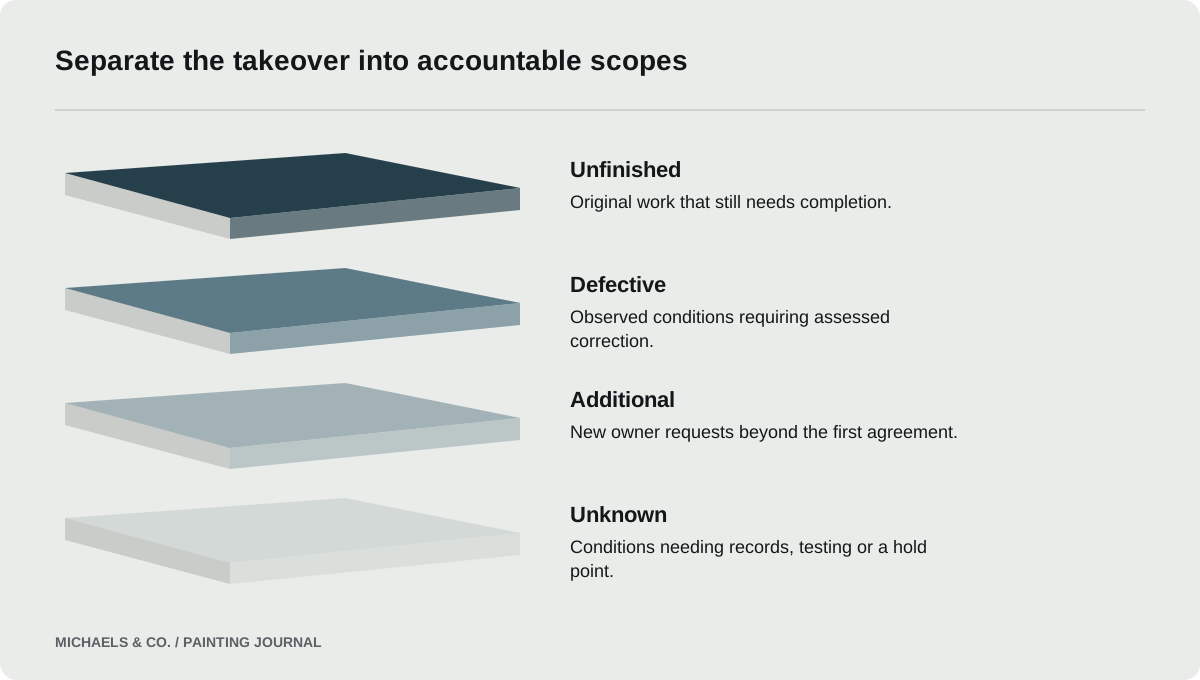
Divide the proposed takeover into unfinished original scope, correction of defective work and new owner-requested work. A contractor may need to price all three, but combining them into one unexplained total makes the earlier dispute harder to understand.
For example, an untouched bedroom is completion work. Removing and rebuilding a failed coating system may be correction work. Adding previously excluded ceilings is new work. The classification should remain provisional where cause is uncertain. Ask the replacement contractor to describe the condition and proposed treatment rather than simply agreeing that the previous painter was incompetent. A clear scope gives the owner useful information without asking the new contractor to decide legal responsibility for costs outside their role.
Find out what is already on the surface
Collect labeled leftover materials, product schedules, invoices available for the project and messages about substitutions. Ask the original contractor for a factual list of primers and finish coatings applied by location, even if the relationship has deteriorated. The replacement needs this information to evaluate the next system.
A container on site does not prove that its contents were applied everywhere, so record uncertainty rather than filling gaps with assumptions. If the coating identity or condition cannot be established, the new contractor may need an appropriate assessment or limited testing before specifying work. The technical data for an example coating illustrates why preparation and compatibility are product-specific questions. It is not a universal answer for whatever the first crew used.
Assess the substrate before promising a quick finish
A replacement painter may discover loose earlier layers, contamination, moisture or unfinished repairs beneath a superficially acceptable coating. Ask how those conditions will be evaluated and which discoveries would require a revised scope. Do not assume that every problem can be corrected with a bonding primer or one more finish coat.
For older or unknown coatings, preparation must account for relevant lead and other hazards before abrasion or removal. A takeover deadline does not eliminate those requirements. If the issue belongs to another trade, such as an active leak or damaged material, identify the responsible party and sequence. The new contract should not silently turn a painter into the guarantor of an unresolved building condition that was never investigated.
Obtain an itemized completion and correction estimate
The replacement proposal should identify the affected surfaces, necessary preparation, products, protection, access and acceptance process. Ask for allowances to be explained and for uncertain conditions to have a documented change procedure.
| Scope group | Useful detail |
|---|---|
| Completion | Original areas and tasks still untouched |
| Correction | Observed defect, proposed remedy and extent |
| New work | Owner additions beyond the earlier agreement |
| Uncertainty | Assessment, allowance or hold point before proceeding |
An itemized estimate does not itself establish what the first contractor owes. It does make the actual recovery plan clearer and gives an adviser or dispute process a better basis for distinguishing necessary correction from unrelated upgrades.
Resolve the old agreement before confusing the new one
Review termination, access, payment and dispute terms in the original contract. The new painter should not be asked to proceed on the assumption that the earlier agreement has ended merely because calls are unanswered. Obtain appropriate advice where the status is disputed.
The FTC's consumer guidance emphasizes preserving records and understanding written terms. For covered Massachusetts HIC work, state contract guidance is relevant, but applicability must be checked. Do not assume that every interior repaint has identical HIC remedies. Keep the replacement contract distinct: it should state the new contractor's work, price and responsibilities without pretending to settle the old contractor's legal obligations.
Handle tools, materials and access responsibly
An absent contractor may leave ladders, equipment or purchased materials behind. Record what remains and ask for appropriate instructions or legal guidance about handling it. Do not sell, discard or hold tools as leverage based on a forum comment. Ownership and lawful disposition are separate from the frustration of an unfinished job.
Coordinate keys, alarm access and scheduling through the authorized owner or manager. Tell the replacement contractor what areas can be entered and which items should remain undisturbed pending assessment. Where materials are available for reuse, confirm suitability and ownership before relying on them in the new price. A clean operational handover prevents the replacement project from inheriting avoidable disputes unrelated to the quality of the painting.
Define what the replacement contractor will stand behind
Ask the new contractor to identify the completed system they will warrant and any conditions outside that promise. A reasonable discussion should address retained earlier coatings, known substrate limitations and repairs performed by others. Do not accept a blanket disclaimer without understanding its practical effect, but do not assume the replacement automatically guarantees every hidden part of the first job.
Record inspection and correction procedures in the new agreement. Keep photographs before and after the takeover and retain final product information. The new project should end with a clear accepted condition, not another vague assurance that everything has been fixed. A well-defined takeover allows the owner to finish the work while preserving an accurate history of what each contractor actually performed.
Questions & answers
Can the new painter tell me what the old contractor owes?
The new painter can provide a technical assessment and itemized correction estimate within their expertise. Legal responsibility for those costs depends on the earlier agreement and facts. Separate necessary completion and correction from new upgrades so an adviser or dispute process can evaluate the relevant amounts.
Should we repaint immediately to make the house usable?
Address urgent property and occupancy needs appropriately, but preserve evidence before nonurgent alteration. Identify applied products and assess underlying problems first. A quick finish may hide defects or complicate the earlier dispute. Document any urgent intervention, why it was needed and the condition before work.
Does a replacement painter have to warranty the previous crew's work?
The new contractor's responsibility depends on the new agreement and the work performed. Discuss retained coatings, substrate conditions and repairs by others before signing. Ask what the proposed warranty covers and excludes, rather than assuming the takeover creates an unlimited guarantee of the entire existing system.
Sources & further reading
- Massachusetts home improvement contract sample languageCovered HIC contracts require detailed scope, materials, dates and payment terms; applicability must be checked.
- FTC: How to avoid a home improvement scamFTC consumer guidance favors written scope and documented payments and identifies pressure and advance-payment warning signs.
- Sherwin-Williams Emerald Interior Satin product dataExample manufacturer instructions specify recoat time and film build under stated conditions; use the actual selected product's current sheet.
Reader discussions
These conversations describe problems people encountered. They do not establish the cause of a defect or replace product instructions and applicable requirements.