Who Pays to Repaint a Leased Office? Define Landlord and Tenant Responsibilities First
Responsibility for repainting a leased office should be resolved in the lease, work letter and written approvals before a contractor is engaged. Establish who pays, who approves the finish, what existing damage must be repaired and whether the tenant must restore the space later. Residential landlord rules should not be assumed to govern a commercial lease. A painting quote cannot settle obligations that the landlord and business tenant have left undefined.

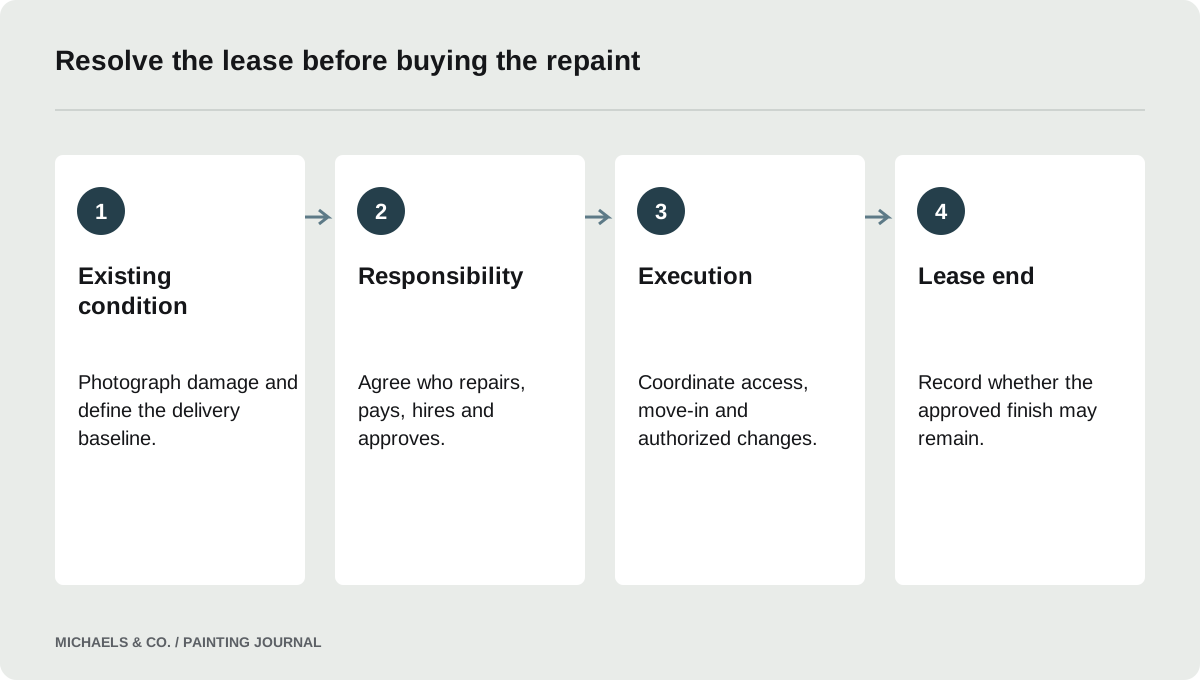
Read the documents as one agreement
Commercial painting obligations may appear in several places: the lease, a tenant-improvement work letter, an offer, a condition schedule or later correspondence. Start by collecting those documents and identifying which one controls if they conflict. Ask the lease adviser to clarify ambiguous obligations before spending money on work that may need to be removed.
In a prospective tenant's account, an employer wanted painting quotes before committing to two office rooms, while the landlord would not perform the repaint. That is a purchasing problem tied to the lease negotiation, not merely a paint-price question. Establish the landlord's proposed delivery condition and the tenant's desired condition separately so the quote measures the actual gap.
Photograph the condition before discussing improvements
Record the walls, ceilings, doors and trim before furniture obscures them. Include adhesive, holes, stains, damaged corners and previous repairs. Describe what is visible without assuming its cause. Photographs should show both close detail and enough surrounding context to locate the condition later.
Give the landlord and tenant an opportunity to agree on that baseline. If the space is described as ready for paint, clarify whether that means structurally sound surfaces, completed patching, a particular finish level or simply a vacant room. These phrases are not interchangeable. A condition record also helps distinguish existing damage from damage caused during the tenant's move or occupancy. Keep it with the lease records, not only in the painter's project folder.
Separate delivery work from tenant preferences
The landlord may agree to repair damage while the tenant pays for a different color or upgraded finish. Another arrangement may provide a financial allowance rather than completed work. State which arrangement applies and identify who verifies the repairs before painting begins.
Do not merge a damp-wall investigation or an unresolved building leak into a cosmetic allowance. Determine who is responsible for diagnosing and correcting the building condition, then define the finishing work that follows. The tenant's preferred color does not answer whether the underlying surface is ready. Likewise, accepting a credit does not automatically define the scope of a contractor's work. If the parties disagree over an existing defect, resolve that disagreement through the lease process rather than asking the painter to adjudicate it.
Obtain approval for more than the color
A landlord's approval may need to cover products, preparation, contractors, working hours and building access. Ask what written submission is required and who has authority to approve it. A building manager's informal comment may not satisfy the owner's approval procedure.
- Confirm the surfaces and areas included.
- Record colors, sheen and any product restrictions.
- Identify preparation and repair responsibilities.
- State access hours, loading and protection requirements.
- Confirm required contractor documentation through the owner.
- Keep the written approval with the accepted scope.
These are practical coordination points rather than a universal commercial lease checklist. The agreement and the building's requirements determine which ones apply. Do not schedule application based on an assumption that approval will arrive after the crew is mobilized.
Define who hires and who can change the work
The party paying the bill is not always the party giving day-to-day instructions. A landlord might fund an allowance while the tenant contracts with the painter, or the landlord might retain the contractor and let the tenant select colors. Make the contracting relationship explicit.
Identify who can approve additions, substitutions and schedule changes. If the tenant asks a crew to paint an extra room, the contractor needs a clear authorization route rather than conflicting instructions from landlord and tenant. Written project terms are consistent with the FTC's general consumer guidance, but commercial authority and liability depend on the actual agreement. Treat the written authorization process as a project-control measure, not a claim that every lease follows the same legal rule.
Coordinate painting with the move-in sequence
A vacant space is usually easier to prepare and protect than one filled with desks, cabling and boxed inventory. However, the painter may not be able to begin until landlord repairs are completed or access is formally released. Build a schedule that shows those dependencies rather than assigning an isolated finish date.
Include time for product-specific conditions before furniture placement or cleaning. Determine who moves items if the schedule slips and the tenant must occupy part of the space. If the business will operate during work, create a separate occupied-building plan for access, air management and communication. The lease commencement date and the paint completion date are business commitments; neither should be used to disregard coating instructions or unresolved site conditions.
Clarify what happens when the lease ends
A tenant may prefer a strong brand color now but face a restoration obligation later. Read the lease language and obtain clarification before approving a finish that could require extra preparation or recoating. Ask whether an approved alteration is also approved to remain at surrender.
Record the exact condition expected at the end of the tenancy: removal of signs or adhesive, repair of installation holes, a specified color or another agreed finish. Avoid relying on a general statement that the landlord “does not mind” the work. Keep the approved product and color schedule so a later team can understand what was applied. Lease-end repainting should be evaluated against the agreement and condition record, not against an unsupported claim that all tenants always repaint.
Close out the work for both property and business records
When painting is complete, inspect it against the accepted scope and document any remaining corrections. Confirm that common areas used for loading and access have been restored. Provide the tenant and landlord with the records each needs, subject to their agreement: products, colors, completed repair scope and any applicable maintenance restrictions.
If the work was funded through an allowance, collect the documents required to support reimbursement before the deadline. Those requirements should already have been agreed rather than discovered after payment. Retain photographs of the accepted condition at handover. They become the starting point for future maintenance and lease-end discussions. A clear closeout prevents a simple office repaint from becoming a recurring disagreement over who authorized, paid for or damaged which surface.
Questions & answers
Does the landlord normally have to paint an office before leasing it?
There is no useful universal answer for commercial premises. The lease negotiation and delivery-condition agreement determine who undertakes the work. Ask for the condition to be described in writing and compare it with the existing space. Do not assume residential rental practices establish the landlord's obligation in a business lease.
Can a tenant choose a painter without asking the landlord?
Check the lease and building approval process first. The landlord may require approval of contractors, working hours, products or alterations even when the tenant pays. Obtain the required written permission and identify who can authorize changes during the work so the contractor does not receive conflicting instructions.
Does permission to paint mean we can leave that color when moving out?
Not necessarily. Approval to perform an alteration and the condition required at lease end may be separate terms. Ask for written clarification before the work begins, especially for strong colors, specialty finishes or branded graphics. Keep that clarification with the original condition record and the final product schedule.
Sources & further reading
- FTC: How to avoid a home improvement scamFTC consumer guidance favors written scope and documented payments and identifies pressure and advance-payment warning signs.
Reader discussions
These conversations describe problems people encountered. They do not establish the cause of a defect or replace product instructions and applicable requirements.